

Subnautica
Unknown Worlds
I spent my time with Subnautica treating it less like a traditional action game and more like a personal expedition into an unfamiliar ocean. Its central idea is simple to describe: survive in an underwater open world. In practice, that capability changes the rhythm of almost everything. Exploration is not just about reaching the next marker; it is about deciding how far I can go, what I can carry, and whether I have enough supplies to return safely.
That focus makes this adventure game unusually good at creating tension without constantly throwing enemies at me. A quiet dive can become a problem because I stayed underwater too long, followed an interesting passage too deeply, or used an important resource before understanding its value. I found myself remembering locations, planning routes, and paying attention to the environment in a way I rarely do in more conventional mobile games.
Subnautica is developed by Unknown Worlds, and the mobile release is listed at $9.99. It is rated for Everyone 10+, with a 4.6 average from around 6.3 thousand ratings and over 100 thousand installs. Those figures suggest a healthy audience, but they do not fully explain the appeal. The real reason to consider it is the unusual combination of discovery, preparation, and risk.
Why the underwater open world is the real feature
Many adventure games use an open map as a backdrop for missions. Here, the ocean itself is the challenge. I am not simply moving across a large landscape from one objective to another. I am learning how the environment behaves, which areas are safe enough for a quick visit, and which journeys require better preparation.
The underwater setting gives ordinary decisions more weight. A piece of material is not just something to collect; it may determine whether I can make a useful tool, improve my equipment, or extend an expedition. A new location is not merely a scenic view; it can reveal a safer route, a valuable resource, or a reason to rethink how I approach future dives.
Related News






This is where the game separates itself from lighter survival adventures on Android and iOS. In many alternatives, gathering becomes a repetitive chore between story moments. In my experience here, gathering is part of the story because it teaches me how to read the world. I became more confident not because the ocean became less mysterious, but because I gradually understood what my surroundings were telling me.
The open-world design also avoids making every discovery feel like a checklist item. I often went somewhere because the landscape looked unusual rather than because I had been explicitly told to visit it. That freedom is valuable for players who enjoy curiosity-driven exploration, although it can feel less comfortable if you prefer a tightly guided campaign with constant instructions.
Exploration feels like a chain of decisions
The most important skill is not fast movement. It is deciding when to turn back. I learned to treat every trip as a small plan: gather what is immediately useful, identify a recognizable route home, and leave enough room for unexpected finds. That habit sounds cautious, but it prevents the frustrating feeling of losing progress simply because I became too ambitious.
Gallery
A useful approach is to separate scouting trips from resource trips. On a scouting dive, I focus on landmarks and entrances rather than filling my inventory. On a resource run, I already know where I am going and can spend more time collecting. This simple distinction made my sessions more efficient and reduced the temptation to improvise when I was already low on supplies.
Another practical tip is to avoid treating every visible object as equally important. Early in a session, I wanted to pick up everything that looked interesting. That quickly created clutter and made it harder to decide what deserved another trip. Once I began prioritizing materials connected to my immediate plans, exploration felt less like random searching and more like purposeful preparation.
What a normal session feels like
A typical session can begin quietly. I may spend a few minutes organizing what I have, choosing a destination, and checking whether I am equipped for the route. Then the mood changes as I move away from familiar surroundings. The water becomes less predictable, visibility can feel more important, and every detour creates a question: is this worth the additional risk?
That structure works particularly well on a phone or tablet because the game does not require every session to end with a major victory. I can make progress by learning a route, collecting useful materials, or finding a new place to investigate later. If I only have a short break, I can still complete a small objective. If I have more time, I can commit to a deeper expedition.
The downside is that the game asks for patience. It is not the ideal choice when I want instant rewards, rapid combat, or a constant stream of clearly marked tasks. Some sessions are deliberately slow, and the payoff may be understanding rather than unlocking something immediately visible. That is satisfying for me, but it will not suit everyone.
How the survival loop works in practice
The survival systems are most effective when they remain connected to exploration. I am not managing resources in isolation from the world; I am managing them because the world is asking me to go farther. Every improvement has a practical consequence. Better preparation means I can stay out longer, investigate more confidently, and return with information instead of merely hoping I got lucky.
I found it helpful to think in terms of expedition roles. One trip might be about learning the layout of a region. Another might focus on collecting materials. A third might be aimed at reaching a location that previously seemed too demanding. When I gave each outing a purpose, the survival mechanics felt meaningful rather than administrative.
The inventory is part of that decision-making. Carrying too much of one material can leave no room for something more valuable later, while carrying too little can make a trip feel wasteful. I started leaving familiar items behind once I knew I could find them easily again. That small change made my storage and travel choices much more deliberate.
For new players, I recommend resisting the urge to rush toward the most visually dramatic area. Familiar zones are useful training grounds. They let me learn movement, resource priorities, and return routes without adding unnecessary pressure. Once those basics felt natural, I could approach less familiar parts of the ocean with a clearer plan.
The best everyday scenario
The game works especially well for someone who wants a focused evening activity rather than a quick arcade match. Imagine finishing work or school, having roughly half an hour, and deciding to prepare for one specific expedition. I can organize my supplies, revisit a known area, collect what I need, and return with a clear sense of progress. The session has a beginning, a purpose, and a conclusion without requiring me to finish a large mission.
It is also a strong fit for players who enjoy sharing discoveries with friends, even when they are playing alone. I found myself wanting to describe unusual places, unexpected dangers, and mistakes that taught me something. The game creates stories through decisions, not only through scripted scenes, so two players can remember very different moments from their time in the same world.
Families should still consider the Everyone 10+ rating in context. The experience is not simply a relaxing aquarium tour. The ocean can create fear and pressure, especially when visibility is limited or a route feels unfamiliar. A younger player who enjoys exploration and can handle suspense may have a good time, while someone sensitive to underwater tension may prefer a gentler adventure.
Controls, pacing, and mobile habits
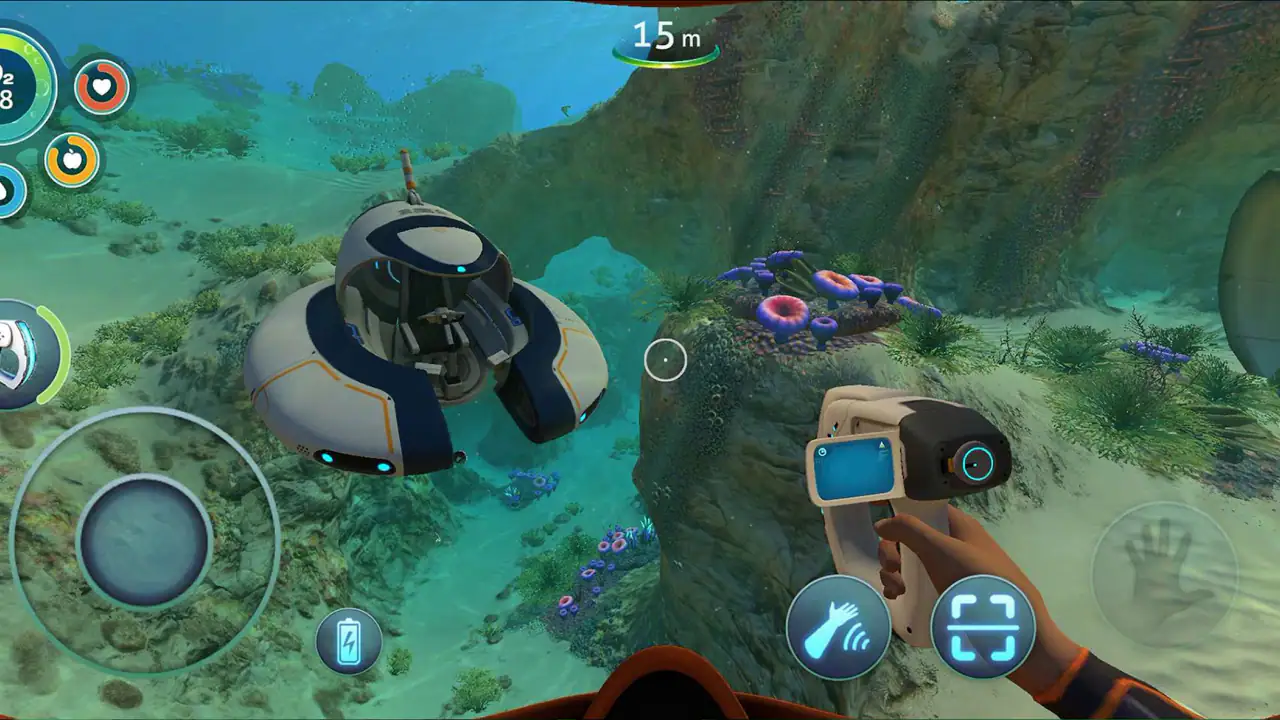
Playing a large exploration game on a touchscreen requires adjustment. I needed time to become comfortable with movement, looking around, interacting with objects, and managing inventory without losing awareness of my surroundings. The controls are most manageable when I avoid rushing. Deliberate movements help more than trying to play as if this were a fast competitive game.
Short mobile sessions can work, but I would not call this a casual game in the usual sense. The world rewards attention, and interruptions can be inconvenient when I am far from safety or in the middle of organizing an expedition. I prefer playing when I know I can concentrate for a while, especially before attempting a new area.
The current version is 1.22.83416, and the game requires Android 10 or later. That is useful to check before purchasing, particularly if the device is older. The price is a one-time $9.99, while in-app purchases are listed at $0.49 per item. For me, the main buying decision is less about the small optional purchase amount and more about whether I genuinely enjoy slow, exploratory survival gameplay.
Where the experience is strongest—and where it asks for patience
The biggest strength is atmosphere with purpose. The ocean is beautiful, but the beauty is not merely decorative. It affects how I navigate, what I notice, and how confident I feel. A familiar location can become meaningful because I remember what happened there, not because the game labels it as important.
The second strength is the way progress comes from understanding. I do not feel powerful simply because I accumulated items. I feel more capable because I learned which preparations matter and which risks are unnecessary. That kind of progression is more personal than a straightforward upgrade ladder, and it kept me interested even during quieter sessions.
The tradeoff is friction. Exploration can involve backtracking, inventory decisions, and periods where the next useful step is not immediately obvious. Players who need constant direction may interpret that as a lack of momentum. I sometimes had to accept that confusion was part of the intended experience rather than a sign that I was playing incorrectly.
Another limitation is the emotional tone. The game can be peaceful, but it is not always comfortable. The underwater setting naturally creates uncertainty, and the deeper I went, the more important preparation became. Anyone looking for a bright, low-pressure adventure should know that the atmosphere may be more intense than the store summary suggests.
How it compares with usual alternatives
Compared with a conventional mobile adventure game, this offers more freedom and fewer immediate instructions. A guided adventure is better if I want a clear sequence of objectives, frequent story beats, and minimal resource management. Subnautica is better when I want the satisfaction of making my own route and learning through consequences.
Compared with a typical survival game, the underwater setting gives the loop a stronger sense of place. Resource collection is not just about building a larger stockpile. It is tied to movement, visibility, distance, and the question of whether I can safely return. That makes preparation feel more connected to exploration than in survival games where the environment can become familiar too quickly.
It also differs from a pure exploration game because the ocean is not only there to admire. I have to respect it. The need to prepare gives discoveries more value, but it also means the game is less immediately relaxing than a sightseeing-focused experience. Choosing between these styles is the clearest way to decide whether it belongs on your device.
Who gets the most from the purchase
I would recommend it most strongly to players who enjoy discovery, environmental storytelling, and gradual mastery. If you like making a plan, changing it after learning something new, and returning to a familiar area with better knowledge, this is an unusually rewarding adventure. The open world gives you room to set your own pace without turning every session into a race.
It is also a good choice for someone who has outgrown very simple mobile survival games but does not want a purely combat-focused experience. The tension comes from the environment and from your decisions. That makes the game feel thoughtful rather than reflex-driven.
I would hesitate to recommend it to players who want a compact game that can be understood in a few minutes. I would also suggest choosing a more guided alternative if you dislike backtracking, getting temporarily lost, or deciding for yourself what deserves attention. The price is reasonable for the depth I received, but only if the slower pace is part of what you want.
My strongest advice is to approach each dive with a modest goal. Do not measure success only by how much you collect or how far you travel. A safe return with a better route, a clearer understanding of a region, or one useful discovery can be a genuinely successful session. That mindset turns the game’s slower moments into its main attraction.
After spending time with it, I see Subnautica as a game built around one powerful promise: the underwater world should feel like a place I must learn, not a map I simply clear. Its survival mechanics support that promise, and its best moments come when preparation, curiosity, and caution meet. The experience has real friction, especially for players who prefer direct objectives or fast action, but that friction is also what gives the exploration weight.
For me, the decision is straightforward. If you want an adventure that lets you set out with a plan, discover something unexpected, and return with a story that came from your own choices, this is worth considering. If you want effortless progress and immediate excitement, I would look elsewhere. The real reward is not merely reaching a new place; it is becoming capable of returning there on your own terms.
FAQs for Subnautica
What is Subnautica, and what kind of game is it?
Subnautica is an open-world survival and exploration game set on an alien ocean planet. After a spaceship crash, you must explore underwater environments, collect resources, craft equipment, build shelters, and uncover the story behind the planet. The game combines peaceful exploration with tense survival moments, especially when diving into dark, unexplored areas inhabited by dangerous creatures.
Is Subnautica available on Android and iOS devices?
Subnautica is officially available on several platforms, but users should check the current Google Play Store or Apple App Store listings before downloading because availability can vary by region and device. The game is demanding, so compatible hardware, sufficient storage, and a supported operating system are important. Avoid unofficial mobile downloads, as they may be unsafe or unrelated to the original game.
Does Subnautica require an internet connection to play?
Subnautica is primarily a single-player experience and generally does not require a constant internet connection once the game has been installed. An internet connection may still be needed for downloading the app, verifying a purchase, receiving updates, or using platform-related services. Because requirements can change between versions, it is best to review the store listing before traveling or playing offline.
Is Subnautica suitable for children and casual players?
Subnautica can be enjoyable for casual players, but it is not always relaxing. The game includes survival mechanics, limited resources, environmental hazards, and frightening encounters with large underwater creatures. Some sections may feel intense or unsettling, particularly for younger players or anyone uncomfortable with deep water. Parents should check the official age rating and consider whether these themes are appropriate.
What should I know about Subnautica’s performance and storage requirements?
Subnautica offers a large world with detailed underwater environments, so performance depends heavily on the device or platform being used. Older or less powerful hardware may experience longer loading times, reduced visual quality, or occasional performance issues. Before downloading, make sure you have enough free storage for the base installation and updates, and close background apps to improve stability during play.
Pros
- Immersive underwater world with varied biomes to explore.
- Strong survival mechanics encourage careful planning and resource use.
- Compelling mystery keeps exploration rewarding from start to finish.
- Base building offers plenty of creative freedom and useful customization.
- Atmospheric sound design makes the ocean feel alive and unpredictable.
Cons
- Some areas can feel dark or difficult to navigate without preparation.
- Resource gathering becomes repetitive during longer play sessions.
- Performance may vary on older phones and tablets.
- The touch controls can feel awkward during fast underwater movement.
- Limited guidance may leave new players unsure what to do next.


